


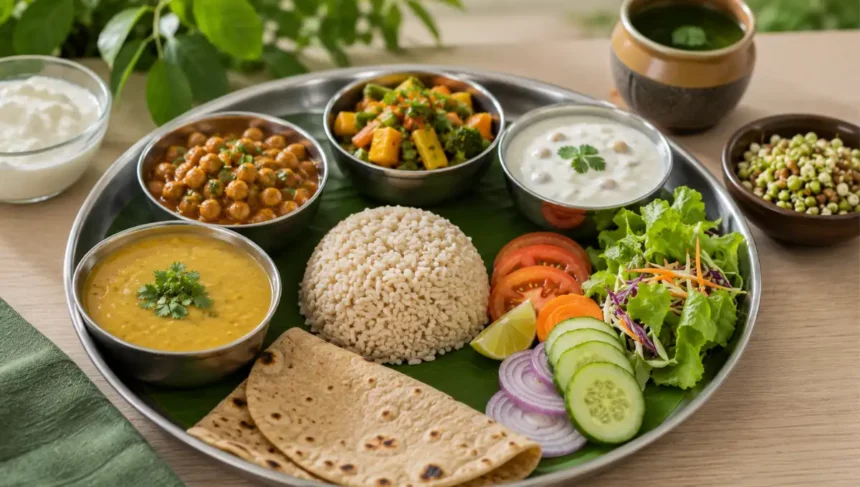
What Does a Healthy Indian Plate Look Like?
The typical Indian thali, generous rice or roti, a small bowl of dal, a vegetable or two, has a comforting, familiar shape. But national data shows most Indian plates have quietly drifted out of balance, leaning heavily on refined carbohydrates while falling short on protein and vegetables. Here is what a genuinely healthy Indian plate looks like, based on official national guidelines.
Indian meals are often assumed to be inherently balanced, built around grains, lentils, vegetables, and dairy, all cooked with spices that carry their own nutritional value. There is truth to that assumption, but a large national study published in 2025 suggests the everyday reality on most Indian plates has shifted considerably from that ideal.
A nationwide study published in Nature Medicine, conducted by the Indian Council of Medical Research and the Madras Diabetes Research Foundation, analyzed the diets of over 18,000 adults across India and found that 62 percent of daily calories came from carbohydrates, largely from refined sources like white rice, milled wheat flour, and added sugar, one of the highest carbohydrate shares in the world. The researchers linked this pattern to a 15 to 30 percent higher risk of type 2 diabetes, prediabetes, and obesity, and found that replacing just 5 percent of daily calories from carbohydrates with plant or dairy protein was associated with meaningfully lower risk.
The good news is that fixing this does not require abandoning traditional Indian food. It mostly means adjusting proportions, the same components most kitchens already use, arranged a bit differently on the plate.
According to official ICMR-NIN guidelines, half of the daily Indian plate should be vegetables, green leafy vegetables, roots, and fruit, while the other half is split between cereals or millets and a combination of pulses, dairy, eggs, fish, or lean meat, with a small allowance for nuts, seeds, and healthy fats. This is a meaningful shift from the typical thali, where rice or roti often dominates the plate while vegetables and protein sources take a smaller supporting role.
Why the Typical Indian Plate Has Drifted Out of Balance
Traditional Indian meals were never designed around a single giant mound of rice or a stack of rotis with a token vegetable on the side. Over recent decades, though, easier access to polished white rice, refined wheat flour, and sugar has shifted the balance of many everyday meals, even as protein and vegetable portions have often stayed roughly the same size or shrunk. Busy schedules, the convenience of quick-cooking refined grains, and the relative cost of pulses and dairy compared with rice or wheat have all played a role in this gradual shift.
This shift matters because carbohydrate quality and quantity directly affect blood sugar regulation, and the national data shows this is not a minor concern. Even switching from white rice to whole wheat or millets did not meaningfully lower risk in the ICMR-INDIAB findings unless total carbohydrate intake also came down, which is an important, often overlooked detail. In other words, simply swapping one grain for another without addressing overall portion size and the balance of other food groups is not enough on its own.
The ICMR-NIN "My Plate for the Day" Model
The Indian Council of Medical Research, through its National Institute of Nutrition, publishes official dietary guidelines specifically designed for Indian eating patterns, culminating in a visual model called "My Plate for the Day."
The ICMR-National Institute of Nutrition's "My Plate for the Day" recommends sourcing macronutrients and micronutrients from a minimum of eight food groups, with vegetables, fruits, green leafy vegetables, roots, and tubers forming essentially half the daily plate. The other half is occupied primarily by cereals and millets, followed by pulses, and the guidelines specifically note that millets can make up 30 to 40 percent of total recommended cereal intake by raw weight, given their density in micronutrients, fiber, and beneficial plant compounds.
For a standard 2,000 kilocalorie diet, this model translates to roughly 250 grams of cereals and millets, 400 grams of vegetables, 100 grams of fruit, 85 grams of pulses or equivalent protein foods, 300 milliliters of milk or curd, and small measured amounts of nuts, seeds, and cooking oil. These figures are meant as a general reference point rather than a strict daily requirement, and individual needs will vary based on age, activity level, and health status.
What stands out most compared with a typical everyday thali is how much smaller a role refined grains are meant to play relative to vegetables, and how much more deliberate a role pulses and dairy are meant to occupy. For many households, simply becoming aware of this intended ratio is the first step toward closing the gap.
Building a Healthy Indian Plate, Component by Component
Breaking the plate model down into its individual components makes it far easier to apply at an actual mealtime, rather than trying to remember percentages while serving food.
1Vegetables and Greens: Half the Plate
Vegetables, including green leafy vegetables and roots, should make up the largest single share of a healthy Indian plate, roughly half. This means a generous serving of sabzi, saag, or salad at most meals, not a small garnish alongside a much larger portion of rice or roti.
2Cereals and Millets: A Moderate Portion, Not the Centerpiece
Rice, roti, and other cereal-based staples remain an important part of the Indian plate, but the guidelines suggest they should occupy a moderate portion rather than dominating the meal. Rotating in millets like jowar, bajra, and ragi for a meaningful share of total grain intake adds fiber and micronutrients that refined rice and maida largely lack, and this rotation can be done gradually, starting with one meal a week and building from there.
3Pulses, Dairy, and Protein Foods
Dal, curd, paneer, eggs, fish, or lean meat should occupy a solid, consistent share of the plate, not an afterthought scooped in small quantities. Given the ICMR findings that Indian protein intake generally runs low relative to carbohydrate intake, this is often the component most worth increasing deliberately.
4Fruit
A daily serving of fresh, whole fruit, roughly 100 to 150 grams, rounds out the produce side of the plate, contributing fiber, vitamin C, and antioxidants that vegetables alone do not fully cover.
5Healthy Fats, Nuts, and Seeds
Cooking oil, ghee, nuts, and seeds are meant to appear in small, measured amounts, contributing flavor and essential fatty acids without dominating the calorie profile of the meal. A small handful of nuts or seeds and a modest amount of oil used in cooking is generally sufficient.
Want more practical, research-backed nutrition guides like this one?
Explore More on HealthZeetA Sample Balanced Thali
Seeing these proportions applied to an actual meal often makes the concept click faster than percentages alone.
6Balanced Vegetarian Thali
One medium roti made from a mix of wheat and millet flour, a small bowl of rice, a generous serving of mixed vegetable sabzi, a bowl of dal, a small bowl of curd, a side salad of cucumber and tomato, and a piece of seasonal fruit reflects the recommended proportions closely, with vegetables and salad together outweighing the grain portion.
7Balanced Non-Vegetarian Thali
The same base of roti, a smaller portion of rice, and a generous vegetable serving, paired with a piece of fish or chicken curry in place of, or alongside, a smaller portion of dal, along with curd and fruit, follows the same essential structure while incorporating animal protein.
Common Mistakes on the Indian Plate
A handful of everyday habits tend to quietly push plates out of the recommended balance, often without anyone noticing over time.
- Oversized rice or roti portions: Refilling rice or adding an extra roti without a matching increase in vegetables or protein.
- Vegetables as garnish, not substance: A small spoonful of sabzi alongside a plate dominated by grain.
- Underestimating dal and curd portions: Treating protein sources as a side condiment rather than a core plate component.
- Relying heavily on refined flour and polished rice: Rarely rotating in millets or whole grain alternatives.
- Excess sugar in tea, sweets, and snacks: Added sugar intake that quietly compounds across the day.
- Deep-fried snacks as a daily habit: Rather than an occasional treat, adding significant saturated fat and refined carbohydrate load.
Practical Tips to Rebalance Your Plate
None of these changes require cooking entirely different food. They mostly involve adjusting quantities and habits around meals your household likely already makes regularly.
- Serve vegetables first and fill roughly half your plate before adding rice or roti.
- Swap a portion of white rice or refined wheat flour for millets like jowar, bajra, or ragi a few times a week.
- Add an extra serving of dal or a boiled egg to meals that feel protein-light.
- Keep a small bowl of curd as a regular part of at least one meal daily.
- Measure cooking oil rather than pouring freely, using a spoon rather than eyeballing it.
- Add a side salad of raw vegetables to lunch or dinner as a simple, low-effort way to boost vegetable intake.
Quick Reference: My Plate Proportions
| Food Group | Approx. Daily Amount (2000 kcal) | Plate Share |
|---|---|---|
| Vegetables, greens, roots | 400g | Largest single portion |
| Cereals and millets | 250g | Moderate, not dominant |
| Pulses, eggs, flesh foods | 85g | Solid, consistent portion |
| Fruit | 100g | Daily, separate from vegetables |
| Milk or curd | 300ml | Daily staple |
| Nuts, seeds, oils/fats | 35g nuts, 27g fat | Small, measured amount |
Frequently Asked Questions
Balance, Not Elimination, Is the Real Fix
A healthy Indian plate does not require abandoning rice, roti, ghee, or any single traditional food. What the official ICMR-NIN guidelines and the national ICMR-INDIAB research both point to is a matter of proportion, filling half the plate with vegetables and fruit, giving pulses and dairy a genuinely solid share rather than a token amount, and treating grains, oils, and sugar with more intentional moderation than many everyday plates currently reflect.
Start by simply serving vegetables first and filling roughly half your plate before adding rice or roti, and building in a consistent protein source at each meal. These small, repeatable shifts, applied to food already familiar in most Indian kitchens, are what actually move a typical thali closer to the balance the national guidelines recommend.

What Does a Healthy Indian Plate Look Like?
See what a healthy Indian plate actually looks like, based on ICMR-NIN…
