


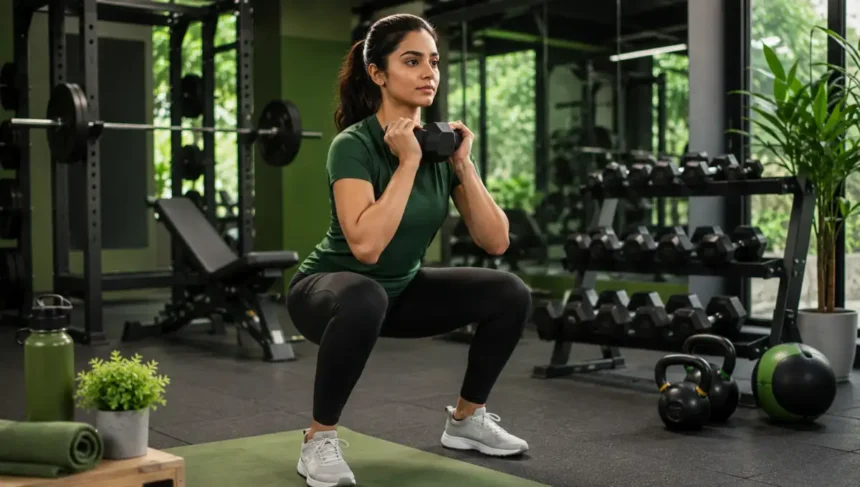
What Is Strength Training? A Beginner's Guide
Strength training often gets mentally filed under "for athletes" or "for bodybuilders," but it is one of the most broadly beneficial forms of exercise for nearly everyone, regardless of age, size, or fitness background. Here is what strength training actually involves, what research says it does for your body, and exactly how to start, even if you have never lifted anything heavier than groceries.
Strength training, also called resistance training, is any form of exercise that makes your muscles work against a force, whether that force is a dumbbell, a resistance band, a weight machine, or simply your own body weight. Over time, this repeated resistance signals your muscles to adapt by growing stronger and, often, larger, a process your body is genuinely built to respond to at any age.
It is genuinely different from cardio, even though both count as exercise. Where cardio primarily challenges your heart and lungs, strength training primarily challenges your muscles and, by extension, your bones, joints, and metabolism, which is exactly why health guidelines recommend both rather than either alone, since neither fully substitutes for the other's specific benefits.
Strength training means working your muscles against resistance, using weights, bands, machines, or your own body weight, to build strength and, over time, muscle mass. According to the National Institute on Aging, part of the NIH, strength training helps maintain muscle mass, improve mobility, and increase the number of healthy, independent years in a person's life, benefits supported by more than 40 years of NIA-funded research.
How Strength Training Actually Works
When you lift a weight or push against resistance, tiny microscopic tears form in your muscle fibers. This is a completely normal, intended part of the process, not an injury, and it is a large part of why muscles feel sore in the day or two following a new or particularly challenging workout.
During rest and recovery, your body repairs these fibers, and with adequate protein and recovery time, rebuilds them slightly stronger and thicker than before. This adaptation depends on a principle called progressive overload, gradually increasing the demand placed on your muscles over time, whether through more weight, more repetitions, or more challenging exercise variations. Without this gradual increase, muscles have little reason to keep adapting once they become accustomed to a given level of resistance, which is why simply repeating the exact same routine indefinitely eventually stops producing new gains.
Benefits of Strength Training
The National Institute on Aging notes that researchers supported by NIA have studied the effects of strength training for more than 40 years, identifying multiple benefits including maintained muscle mass, improved mobility, and an increase in the number of healthy years in a person's life. NIA-supported researcher Roger Fielding, PhD, at Tufts University, describes resistance training as the most important exercise component for reducing age-related muscle loss, noting it also helps improve body composition by preserving muscle even during fat loss.
1Builds and Preserves Muscle Mass
Muscle mass naturally declines with age, a process that accelerates without regular resistance stimulus, sometimes amounting to 1 to 2 percent loss per year after age 30 if left unaddressed. Strength training directly counters this, helping maintain functional strength for everyday tasks like carrying groceries, climbing stairs, or getting up from a chair.
2Strengthens Bones
Weight-bearing resistance exercise stimulates increased bone density, which is particularly protective against osteoporosis, a benefit that becomes increasingly important with age, especially for postmenopausal women, whose bone density decline accelerates notably after menopause.
3Supports a Healthier Metabolism
Muscle tissue is more metabolically active than fat tissue, meaning more muscle mass modestly increases the number of calories your body burns at rest. Strength training also improves insulin sensitivity, supporting healthier blood sugar regulation over time, which makes it a genuinely useful tool for metabolic health beyond its more visible physical effects.
4Improves Functional Independence
Beyond appearance or athletic performance, strength training supports the kind of everyday physical capability that keeps people independent longer, balance, the ability to rise from the floor, and resistance to falls and fractures, all of which matter more for daily quality of life than most people initially expect.
5Supports Mental Health
Like other forms of exercise, strength training is associated with reduced symptoms of anxiety and depression, along with improved self-confidence and body image for many people, benefits that appear to be at least partly independent of the physical changes it produces, suggesting the psychological effects are not simply a byproduct of looking or feeling stronger.
Want more practical, research-backed fitness guides like this one?
Explore More on HealthZeetTypes of Strength Training
Strength training does not require a gym membership or expensive equipment. Several distinct approaches all count, and beginners can start with whichever is most accessible, comfortable, and realistic given their current budget and living situation.
6Bodyweight Training
Exercises like push-ups, squats, lunges, and planks use your own body as resistance, requiring no equipment at all. This is an excellent, accessible starting point for beginners to build a foundation of strength and movement patterns.
7Free Weights
Dumbbells, kettlebells, and barbells allow for a wide range of exercises and require your muscles to also engage stabilizing movements, offering functional strength benefits beyond machines.
8Resistance Bands
Bands provide adjustable resistance in a compact, inexpensive format, making them a practical option for home workouts, travel, or as a gentler starting point for beginners easing into resistance training.
9Weight Machines
Gym machines guide movement along a fixed path, which can make them more approachable for complete beginners still building confidence with proper form, though they generally engage fewer stabilizing muscles than free weights.
Key Terms Every Beginner Should Know
Walking into strength training for the first time often means encountering unfamiliar terminology. Getting comfortable with these basics makes following a routine, or a trainer's instructions, far less confusing.
- Rep (repetition): One complete movement of an exercise, such as one push-up or one squat.
- Set: A group of consecutive repetitions performed without resting, such as 10 reps in a row.
- Progressive overload: Gradually increasing weight, reps, or difficulty over time to keep challenging your muscles.
- Compound exercise: A movement that works multiple muscle groups at once, like a squat or push-up.
- Isolation exercise: A movement that targets a single muscle group, like a bicep curl.
- Form: The correct technique for performing an exercise safely and effectively.
How to Start Strength Training as a Beginner
The CDC recommends that adults engage in muscle-strengthening activities involving all major muscle groups on two or more days per week, alongside regular aerobic activity, to gain the most substantial health benefits available from physical activity.
10Start With Bodyweight or Light Resistance
Before adding significant weight, focus on learning correct movement patterns using just your body weight or light resistance bands. This builds a foundation that makes progressing to heavier weights both safer and more effective, and it also gives your joints and connective tissue time to adapt alongside your muscles, which happens on a somewhat slower timeline.
11Aim for 8 to 10 Exercises Covering Major Muscle Groups
A well rounded beginner routine covers the chest, back, shoulders, arms, legs, and core, ensuring balanced development and avoiding overuse of any single muscle group relative to others.
12Start With 1 to 2 Sets, Gradually Building Up
Beginners generally see good results starting with one to two sets of 10 to 15 repetitions per exercise, progressing to more sets and heavier resistance as strength and confidence improve over several weeks.
13Rest Between Sessions
Avoid training the same muscle groups on consecutive days, since muscles need recovery time to repair and grow stronger. Two to three non-consecutive days per week is a reasonable starting frequency for most beginners.
A Simple Beginner Routine
This full-body routine, performed two to three non-consecutive days a week, covers all major muscle groups using minimal or no equipment.
| Exercise | Muscle Group | Sets x Reps |
|---|---|---|
| Bodyweight squat | Legs, glutes | 2 x 10-15 |
| Push-up (or knee push-up) | Chest, shoulders, arms | 2 x 8-12 |
| Resistance band row | Back, biceps | 2 x 10-15 |
| Glute bridge | Glutes, lower back | 2 x 12-15 |
| Plank | Core | 2 x 20-30 seconds |
| Standing calf raise | Calves | 2 x 15-20 |
Common Beginner Mistakes
Learning what to avoid is often just as valuable as learning what to do, since a handful of avoidable mistakes account for a large share of beginner frustration and injury.
- Skipping proper warm-up before jumping into working sets.
- Choosing weight that is too heavy before mastering correct form.
- Training the same muscle groups every day without adequate rest.
- Comparing progress to others rather than tracking personal improvement over time.
- Neglecting protein intake, which is essential for muscle repair and growth.
- Giving up too soon, since visible strength and muscle changes typically take several weeks to become noticeable.
Safety Tips for Beginners
- Warm up with 5 to 10 minutes of light movement before starting your workout.
- Prioritize correct form over lifting heavier weight, especially when learning new exercises.
- Breathe consistently throughout each repetition rather than holding your breath.
- Stop and reassess if you feel sharp pain, as opposed to normal muscle fatigue.
- Consider a few sessions with a qualified trainer to learn proper technique if you are new to lifting.
- Consult a doctor before starting if you have an existing health condition, joint issue, or have been inactive for an extended period.
Quick Reference: Beginner Strength Training Basics
| Element | Beginner Recommendation |
|---|---|
| Frequency | 2-3 non-consecutive days weekly |
| Sets per exercise | 1-2, progressing gradually |
| Reps per set | 10-15 |
| Exercise selection | 8-10 exercises covering major muscle groups |
| Rest between sets | 30-90 seconds |
| Equipment needed | None required, bodyweight is a valid start |
Frequently Asked Questions
A Foundational Habit Worth Starting Today
Strength training is simply the practice of working your muscles against resistance, whether that resistance comes from your own body weight, a resistance band, or a set of dumbbells. Decades of NIA-supported research point to genuine, wide-ranging benefits, preserved muscle mass, stronger bones, better metabolic health, and improved everyday function, that make it one of the more valuable habits available to nearly anyone, regardless of age or starting fitness level, and one that becomes more, not less, important as the years go by.
Start with bodyweight exercises, focus on learning correct form before adding heavy resistance, and aim for two to three sessions a week covering all major muscle groups. The specific exercises matter less than starting consistently and progressing gradually over time, so pick something you can realistically repeat week after week rather than the most intense program you can find.
What Is Strength Training? A Beginner’s Guide
Learn what strength training actually is, its research-backed benefits, and how to…
