


What Are Essential Oils and How Are They Made?
Essential oils show up in diffusers, skincare, and candles everywhere, but the term itself has a precise meaning that most bottles on store shelves do not actually meet. This guide explains what essential oils really are, the extraction methods that produce genuine ones, and what research actually supports about their use.
Essential oils are concentrated liquids extracted from plants, capturing the compounds responsible for a plant's characteristic scent, and often, its flavor and some of its biological activity. The word "essential" here does not mean necessary, it refers to the plant's essence, the concentrated aromatic compounds drawn out through extraction, a usage that traces back to older alchemical language rather than modern chemistry terminology.
Not every fragrant plant liquid sold as an "essential oil" is actually one in the technical sense, and understanding the difference between genuine extraction methods and shortcuts involving synthetic fragrance or chemical solvents is genuinely useful before buying or using them. This distinction affects not just cost, but also what you can reasonably expect the product to do.
According to the National Cancer Institute, essential oils are volatile liquid substances extracted from aromatic plant material specifically through steam distillation or mechanical expression, and oils produced with the help of chemical solvents are not considered true essential oils. This distinction matters, since it separates genuine essential oils from many "fragrance oils" or diluted products that use the term loosely without meeting this technical definition.
What Essential Oils Actually Are
Essential oils are made up of dozens, sometimes hundreds, of naturally occurring aromatic compounds found in specific plant parts, flowers, leaves, bark, peel, or roots, depending on the species. These compounds evolved in plants for reasons like attracting pollinators, deterring pests, or protecting against microbial threats, functions that partly explain why certain essential oils show measurable antimicrobial or insect-repelling properties in laboratory studies.
Despite the name, essential oils are not oily or greasy the way a cooking oil is. They are volatile, meaning they evaporate readily at room temperature, which is exactly what allows their scent to be perceived through the air, whether from a diffuser, a perfume, or simply a crushed leaf.
How Essential Oils Are Made
The method used to extract an essential oil affects its purity, cost, and in some cases, its chemical composition, which is part of why extraction method is worth understanding rather than assuming all "essential oils" are produced the same way.
The National Cancer Institute's PDQ summary on aromatherapy explains that essential oils are volatile liquid substances extracted from aromatic plant material by steam distillation or mechanical expression, and that oils produced with the aid of chemical solvents are not considered true essential oils. The summary also notes that as essential oils age, their chemical composition changes, and many do not carry a formal expiration date the way packaged food products do.
1Steam Distillation
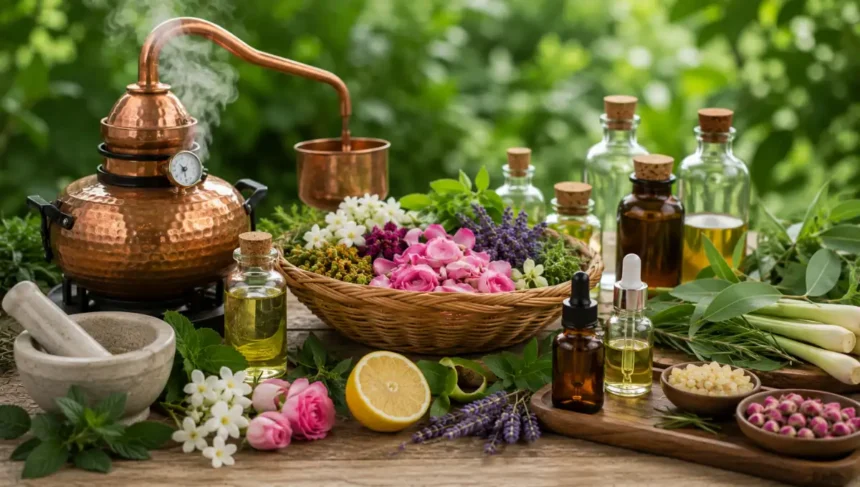
Steam distillation is the most common method used for genuine essential oil production. Steam passes through plant material, causing aromatic compounds to release and travel with the steam, which is then cooled and condensed, separating the essential oil from the resulting water, known as hydrosol or floral water.
2Cold Pressing or Mechanical Expression
Cold pressing, technically called mechanical expression, is used primarily for citrus oils like lemon, orange, and bergamot, where the oil is physically pressed out of the fruit's peel without applying heat. This method preserves compounds that might be altered by the heat used in steam distillation.
3CO2 Extraction
Carbon dioxide extraction uses pressurized carbon dioxide as a solvent to pull aromatic compounds from plant material, then releases the pressure so the CO2 returns to a gas state, leaving behind the extracted oil without residual solvent. This method is prized for capturing a fuller range of a plant's compounds compared with steam distillation, though it requires more specialized equipment.
4Solvent Extraction and Why It Is Different
Some fragrant plant materials, particularly delicate flowers like jasmine, do not hold up well to steam distillation. These are sometimes processed using chemical solvents to produce what is technically called an absolute, not a true essential oil, since trace solvent residue can remain. This distinction is exactly why the official definition of essential oils specifically excludes chemically solvent-extracted products.
Want more practical, research-backed wellness guides like this one?
Explore More on HealthZeetWhat Determines Quality and Purity
Essential oil quality varies considerably between brands and products, and price differences often reflect genuine differences in sourcing, yield, and processing rather than marketing alone.
5Yield and Plant Material Required
Some plants yield essential oil generously, while others require enormous quantities of raw material for a small amount of finished oil, which directly affects price. Rose and sandalwood oils, for example, require substantially more plant material per bottle than something like lavender or tea tree oil, explaining their higher cost.
6Adulteration and Dilution
Because pure essential oils can be expensive to produce, some commercial products are diluted with cheaper carrier oils or synthetic fragrance compounds without always being clearly labeled as such. Reputable brands generally provide batch testing information, botanical names, and country of origin, details worth checking if purity matters for your intended use.
7Storage and Shelf Life
Essential oils oxidize over time, particularly citrus oils, and this chemical change can affect both scent and, in some cases, skin sensitivity potential. Storing oils in dark glass bottles away from heat and light helps preserve their original composition for longer.
How Essential Oils Are Believed to Work
The proposed mechanisms behind aromatherapy's effects depend on how the oil is used, inhaled versus applied to the skin, and remain an active area of ongoing research.
When inhaled, aromatic compounds are thought to bind to receptors in the olfactory system, sending signals to the limbic system, the brain region involved in emotion and memory, which may explain reported effects on mood and stress. When applied topically in diluted form, certain compounds may exert localized antibacterial, anti-inflammatory, or mild analgesic effects, mechanisms supported by some laboratory research, though human clinical evidence varies significantly by oil and condition studied.
Common Essential Oils and Their Traditional Uses
A handful of essential oils appear repeatedly across both traditional aromatherapy practice and modern research interest.
- Lavender: Widely used for relaxation and sleep support, among the most researched essential oils for these specific uses.
- Peppermint: Traditionally used for headache relief and to ease nausea, often applied diluted to the temples or inhaled.
- Tea tree: Valued for its antimicrobial properties, commonly used in diluted topical skincare formulations.
- Eucalyptus: Traditionally used to ease congestion, typically through inhalation or steam.
- Citrus oils (lemon, orange, bergamot): Commonly used for mood support and general uplift, produced through cold pressing.
- Frankincense: Used traditionally in meditation and skincare practices, extracted from resin through steam distillation.
What Research Actually Shows
A review published through the National Library of Medicine notes that aromatherapy has been shown to help alleviate symptoms including anxiety, depression, fatigue, sleep disorders, neuropathic pain, nausea, and menopausal symptoms in various studies, with lavender emerging as particularly notable given its broad research base and its designation by the U.S. Food and Drug Administration as Generally Recognized as Safe. The review's authors also emphasize that further high-quality research is still needed to more firmly establish safety and effectiveness across the wider range of essential oils in use.
This mixed but genuinely promising picture is fairly typical across the essential oil research landscape. Some specific applications, particularly inhaled lavender for relaxation and sleep, have a reasonable body of supportive research, while many other claimed benefits rest on smaller studies or laboratory findings that have not yet been confirmed in larger human trials.
Safety Considerations
Essential oils are natural, but concentrated plant extracts still carry real safety considerations that are easy to overlook given how commonly they are used.
The NIH's National Center for Complementary and Integrative Health notes that oral lavender products might be safe short-term at studied amounts, but some people experience side effects like diarrhea, headache, nausea, or burping, and aromatherapy with lavender oil specifically may cause headache or coughing in some people. Topical lavender products may also cause allergic skin reactions, underscoring that even well-studied, generally favorable essential oils are not entirely without risk.
- Never apply undiluted essential oil directly to skin, since this can cause irritation or burns for many oils.
- Citrus oils can cause phototoxic reactions, increasing sun sensitivity if applied to skin before sun exposure.
- Essential oils should not be ingested unless specifically directed by a qualified practitioner, given the concentrated nature of the extract.
- Some essential oils, including lavender and tea tree, have shown hormone-like effects in some studies, worth discussing with a doctor for anyone with hormone-sensitive conditions.
- Many essential oils are toxic to cats and some other pets, even through diffusers, so pet safety is worth researching before diffusing regularly.
- Essential oil use around infants and young children requires particular caution, since their skin and respiratory systems are more sensitive.
Quick Reference: Extraction Methods Compared
| Method | Common Use Case | Considered a True Essential Oil |
|---|---|---|
| Steam distillation | Lavender, eucalyptus, tea tree, frankincense | Yes |
| Cold pressing (expression) | Lemon, orange, bergamot, other citrus | Yes |
| CO2 extraction | Rosemary, ginger, some resins | Yes, by most definitions |
| Solvent extraction | Jasmine, delicate absolutes | No, technically an "absolute" |
Frequently Asked Questions
Understanding the Extraction Process Makes You a Smarter Buyer
Essential oils are genuinely fascinating concentrated plant extracts, produced through specific methods like steam distillation and cold pressing that preserve a plant's natural aromatic compounds without chemical solvents. Knowing this definition helps separate true essential oils from diluted or synthetic products marketed under the same name, and understanding the research landscape helps set realistic expectations for what different oils can and cannot reliably do.
Used thoughtfully, properly diluted for topical use, inhaled rather than ingested without guidance, and sourced from reputable, transparent brands, essential oils can be a reasonable part of a broader wellness routine. As with any concentrated plant compound, a bit of informed caution goes a long way.
What Are Essential Oils and How Are They Made?
Learn what essential oils actually are, how steam distillation and cold pressing…
