



How to Build a Balanced Indian Plate for Better Nutrition
Most Indian meals already contain the right building blocks, grains, dal, vegetables, curd, they just tend to end up in the wrong proportions. This guide walks through exactly how to build a balanced Indian plate, step by step, using official nutrition guidelines, practical portion techniques, and real thali examples you can actually use at your next meal.
Building a balanced plate is less about following a rigid diet and more about arranging familiar foods in better proportion. Most Indian households already cook dal, sabzi, roti or rice, and curd regularly, the issue is rarely a lack of variety, it is how much space each component actually takes up on the plate once everything is served.
This guide breaks the process into clear, practical steps, starting with the plate itself and building outward, component by component, so you end up with a genuinely balanced meal without needing to track calories or follow a rigid meal plan that feels disconnected from how you already cook.
A balanced Indian plate is generally built by filling half the plate with vegetables and salad first, then dividing the remaining half between a moderate portion of cereal or millet and a solid serving of protein, such as dal, curd, paneer, egg, or fish, with a small measured amount of healthy fat and a side of fruit rounding out the day. Building the plate in this order, vegetables first, then protein, then grains, naturally prevents the grain portion from crowding out everything else, which is the single most common imbalance in everyday Indian meals.
Why the Order You Build Your Plate Matters
Most people build their plate in the same order every time without thinking about it, rice or roti first, then a small serving of sabzi, then dal as an afterthought. This default order is exactly why grains tend to dominate Indian plates, since once a generous portion of rice or roti is already served, there is simply less physical space left for vegetables and protein, regardless of good intentions about eating a balanced meal.
A nationwide study published in Nature Medicine, conducted by the Indian Council of Medical Research and the Madras Diabetes Research Foundation, analyzed the diets of over 18,000 adults across India and found that 62 percent of daily calories came from carbohydrates, largely from refined sources like white rice and milled wheat flour, one of the highest carbohydrate shares in the world. The researchers found that replacing just 5 percent of daily calories from carbohydrates with plant or dairy protein was associated with meaningfully lower risk of diabetes and obesity.
Simply reversing the build order, vegetables first, then protein, then grains, is a surprisingly effective, low-effort fix. By the time you get to serving rice or roti, the plate is already mostly full, which naturally keeps the grain portion in check without requiring any calculation or measuring.
Step 1: Start With Vegetables and Fill Half the Plate
The ICMR-National Institute of Nutrition's "My Plate for the Day" recommends that vegetables, fruits, green leafy vegetables, roots, and tubers together form roughly half of the daily plate, with cereals and pulses making up most of the remaining half. For a standard 2,000 kilocalorie diet, this translates to approximately 400 grams of vegetables daily, a substantially larger portion than what typically appears on most everyday Indian plates.
1Combine Cooked Sabzi With a Raw Salad
Rather than relying on a single small bowl of sabzi to cover your entire vegetable portion, pair a cooked vegetable dish with a simple raw salad, cucumber, tomato, onion, or grated carrot. This combination reaches the half-plate target far more easily than cooked vegetables alone.
2Include at Least One Green Leafy Vegetable Most Days
Spinach, methi, or other leafy greens bring iron, folate, and fiber that other vegetables do not fully replace. Rotating in a leafy green dish a few times a week, even in small amounts mixed into dal or a simple stir-fry, adds meaningful nutritional variety.
Want more practical, research-backed nutrition guides like this one?
Explore More on HealthzeetStep 2: Add a Solid Protein Portion
With vegetables already occupying half the plate, the next step is building in a genuine, solid protein portion, not a token spoonful of dal squeezed in around the edges after everything else is already served.
3Choose a Primary Protein Source
Dal, curd, paneer, eggs, chicken, or fish can all serve as your plate's primary protein. Aim for a portion roughly the size of your palm, a bowl of dal that is genuinely a bowl, not a thin ladle over rice, or a piece of fish or paneer comparable in size to your palm, rather than a few token cubes scattered across the plate.
4Combine Plant Proteins for a More Complete Profile
For vegetarian plates, pairing dal or legumes with rice or roti in the same meal creates a more complete amino acid profile than either eaten alone, a combination Indian cuisine has relied on for generations without necessarily naming the underlying nutritional logic behind why dal and rice, or dal and roti, so often appear together.
Step 3: Add a Moderate Portion of Grains or Millets
This is the step most plates get wrong, not because grains are unhealthy, but because they typically arrive first and expand to fill whatever space remains once nothing else has claimed it yet.
5Measure Roughly, Not Precisely
A reasonable portion is about one medium roti or a small bowl of rice, roughly a cupped handful, rather than an unmeasured serving scooped freely. You do not need a kitchen scale, simply serving grains last, after vegetables and protein are already on the plate, tends to naturally control the portion.
6Rotate in Millets Several Times a Week
Swapping white rice or refined wheat flour for jowar, bajra, or ragi a few times weekly adds fiber and micronutrients that refined grains largely lack. Official guidelines suggest millets can reasonably make up 30 to 40 percent of total cereal intake, a target that does not require eliminating rice or wheat entirely.
Step 4: Include Curd or Dairy
A small bowl of curd, roughly 150 to 200 milliliters, is a simple, low-effort addition that contributes calcium, protein, and beneficial bacteria that support gut health. This is one of the easiest components to build in consistently, since curd is already a staple in most Indian kitchens, it often just needs to be served as a deliberate part of the plate rather than an optional side.
Step 5: Add Fruit and Healthy Fats in Small Amounts
7Fruit as a Separate Daily Addition
A serving of fresh, whole fruit, roughly 100 to 150 grams, works well as a mid-meal snack or dessert alternative, adding fiber and vitamin C that vegetables alone do not fully cover.
8Measure Cooking Oil and Ghee
Rather than pouring oil or ghee freely during cooking, using a measuring spoon helps keep fat intake in a reasonable range, generally around one to two tablespoons total across the day's cooking, without eliminating fat entirely, since some dietary fat is necessary for nutrient absorption.
Balanced Thali Examples Across Regions
These five steps apply across India's regional cuisines, even though the specific dishes vary considerably from one kitchen to another, which is exactly what makes this method more useful than a single fixed meal plan.
9North Indian Style
Two rotis made with a wheat and millet flour blend, a generous bowl of mixed vegetable sabzi, a bowl of dal, a small bowl of curd, and a side of cucumber-onion salad reflects the five steps closely, with vegetables and salad together outweighing the roti portion.
10South Indian Style
A modest serving of rice paired with sambar, a generous portion of poriyal or a mixed vegetable stir-fry, a small bowl of curd or buttermilk, and a side salad follows the same underlying structure, using sambar's lentil base to help cover the protein step.
11Non-Vegetarian Style
A piece of fish or chicken curry in place of, or alongside, a smaller portion of dal, paired with a generous vegetable side, a moderate portion of rice or roti, and curd, follows the identical five-step structure while incorporating animal protein as the primary source.
Smart Swaps to Rebalance a Typical Meal
Beyond the five-step build, a handful of small, specific swaps can help rebalance meals that have already drifted toward carbohydrate-heavy defaults.
- Swap a second helping of rice for an extra serving of sabzi or salad instead.
- Swap white rice for a rice and millet blend a few times a week.
- Swap a thin, watery dal for a thicker, more generous dal portion that genuinely functions as a protein source.
- Swap deep-fried snacks for roasted chana, a boiled egg, or a small bowl of curd as an evening option.
- Swap pouring oil freely for measuring it with a spoon during cooking.
Quick Reference: The 5-Step Plate Build
| Step | What to Add | Target Portion |
|---|---|---|
| 1. Vegetables | Cooked sabzi + raw salad | Half the plate |
| 2. Protein | Dal, curd, paneer, egg, or fish | Palm-sized portion |
| 3. Grains/millets | Rice, roti, or millet blend | One medium roti or small bowl |
| 4. Dairy | Curd or buttermilk | 150-200ml |
| 5. Fruit and fat | Fresh fruit, measured oil/ghee | 100-150g fruit, 1-2 tbsp fat daily |
Frequently Asked Questions
The Same Ingredients, Arranged More Intentionally
Building a balanced Indian plate rarely requires new ingredients or unfamiliar dishes, it mostly requires a different build order and a more intentional sense of proportion. Filling half the plate with vegetables first, adding a genuine protein portion, then a moderate serving of grains, followed by curd, fruit, and measured fat, reflects both official ICMR-NIN guidance and a practical, repeatable method you can apply to almost any regional Indian meal, whether it is a North Indian thali or a South Indian rice-and-sambar plate.
Start with the single easiest change, serving vegetables before rice or roti, and let the rest of the five steps follow naturally from there. Small, consistent shifts in how a familiar plate is built tend to produce far more lasting results than an entirely new diet plan that feels disconnected from the food you already know how to cook.
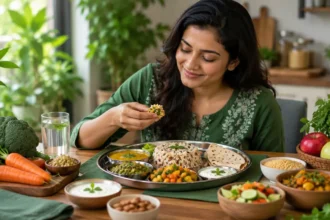
How to Build a Balanced Indian Plate for Better Nutrition
Learn how to build a balanced Indian plate step by step, with…
